Now Reading: Italy in 2026: 10 Destinations Worth Flying To Right Now
- 01
Italy in 2026: 10 Destinations Worth Flying To Right Now

Italy in 2026: 10 Destinations Worth Flying To Right Now
Transatlantic fares to Italy have quietly gotten more competitive heading into 2026 — I’ve tracked round-trips from New York’s JFK to Rome’s FCO for as low as $520 on Norwegian and ITA Airways during shoulder season. That’s a real reason to finally nail down that Italy itinerary.
But Italy isn’t a single destination. It’s a country of 20 distinct regions, several major gateway airports, and a rail network that can move you between cities in under three hours. Where you fly into matters as much as where you want to go. Below are 10 destinations worth building a trip around in 2026 — ranked not by popularity, but by how well they reward the effort of actually getting there.
1. Rome — Still the Best Entry Point for First-Timers
Fly into: Rome Fiumicino (FCO)
FCO remains Italy’s busiest international gateway, served by almost every major carrier including Delta, United, American, Alitalia’s successor ITA Airways, and Lufthansa via Frankfurt. Economy fares from the East Coast typically run $550–$850 round-trip from October through April; expect $900+ in June and July.
Rome in 2026 carries extra energy: it’s a Jubilee Year for the Catholic Church, which draws millions of pilgrims but also triggers major city infrastructure upgrades — including metro expansions and pedestrian zone extensions around the Vatican. Book accommodations at least four months out if you’re traveling between April and October.
Honest tradeoff: The Jubilee crowds in spring 2026 will be genuinely intense near Vatican City. If queues kill your mood, position yourself in the Pigneto or Ostiense neighborhoods instead of Trastevere, and visit the Colosseum on a weekday before 9 a.m.
2. Venice — Worth It, But Fly Smart
Fly into: Venice Marco Polo (VCE) or Treviso (TSF)
Venice itself needs no hype from me — but the logistics do. Marco Polo (VCE) handles most major European connections and some transatlantic routes via code-shares. Ryanair and Wizz Air fly into Treviso (TSF), about 30 km out, where fares from European hubs can drop under €40 one-way.
Venice introduced a day-tripper entry fee (currently €5, likely to continue in 2026 on peak days) — a minor cost, but a signal that the city is actively managing visitor flow. If you’re staying overnight, you’re exempt, which is another argument for booking a hotel on Giudecca or in Mestre.
Honest tradeoff: Staying in Venice proper costs 30–50% more per night than Mestre across the causeway. The atmosphere is incomparable, but if budget is tight, Mestre with a 10-minute train into the city is genuinely fine.
3. Florence — Italy’s Compact Masterclass
Fly into: Florence Peretola (FLR) or Pisa Galileo Galilei (PSA)
Florence Peretola is a small airport with limited direct international service — most travelers connect through Amsterdam, Paris CDG, or Frankfurt. Pisa’s airport, 80 km west, has wider low-cost coverage and a direct train to Florence Santa Maria Novella in about 50 minutes.
Florence rewards slower travel. Three days is the minimum to do the Uffizi, the Accademia, and Oltrarno’s artisan workshops without speed-running everything. In 2026, the new Museo dell’Opera del Duomo expansion is expected to be fully open, adding significant exhibition space around the original Ghiberti bronze doors.
4. Naples — The Underrated Gateway to the South
Fly into: Naples Capodichino (NAP)
Naples Capodichino has expanded its route network considerably, with easyJet and Volotea adding frequencies from northern European cities. From the US, most travelers connect through Rome or Milan. A direct train from Rome Termini to Naples Centrale takes 1 hour 10 minutes on the Frecciarossa — often cheaper than flying if you’re already in Rome.
Naples is the launch pad for Pompeii (40 minutes by Circumvesuviana train), the Amalfi Coast, and the islands of Capri and Ischia. But Naples itself — the street food, the Baroque churches, the underground Greek-Roman ruins — deserves at least two full days before you rush south.
Honest tradeoff: Naples has a reputation for petty theft that’s only partially deserved, but it’s not zero. Keep your phone in a front pocket and avoid the Piazza Garibaldi area after midnight. That’s it — the rest of the city is as safe as any major European metro.
5. Sicily — Two Airports, Endless Options
Fly into: Palermo Falcone-Borsellino (PMO) or Catania Fontanarossa (CTA)
Sicily is Italy’s largest island and, in my experience, one of its most underappreciated long-haul additions. Ryanair flies from a dozen European cities to both Palermo and Catania, often for under €60 one-way. From the US, connections route through Rome FCO or Milan MXP.
Which airport? Fly into Catania if you want to start with Mount Etna and the baroque towns of the Val di Noto — a UNESCO World Heritage cluster including Noto, Ragusa, and Modica. Fly into Palermo for the Arab-Norman architecture, the Ballarò street market, and the western coast. Fly out of the other one and do a loop.
6. Milan — Italy’s Business Capital With a Great Food Scene
Fly into: Milan Malpensa (MXP) or Milan Linate (LIN) or Bergamo Orio al Serio (BGY)
Milan has three airports, which is both convenient and confusing. Malpensa (MXP) is the main international hub, about 50 km from the city center — the Malpensa Express train takes 52 minutes to Milano Centrale. Linate (LIN) is closer (7 km) but handles mostly European routes. Bergamo (BGY), 45 km out, is Ryanair’s Italian fortress and can offer surprisingly cheap fares if you don’t mind the bus transfer.
Beyond fashion week and the Duomo, Milan in 2026 is worth visiting for its food evolution — the Navigli canal district and Isola neighborhood have become genuinely interesting dining destinations, not just tourist infrastructure.
Honest tradeoff: Milan is Italy’s most expensive city. A mid-range hotel near the Duomo runs €180–€250/night in 2025 money. Staying near Porta Romana or Navigli trims that by 20–30% and puts you in more interesting neighborhoods anyway.
7. Cinque Terre — Small Villages, Big Logistics
Fly into: Genoa Cristoforo Colombo (GOA) or Pisa Galileo Galilei (PSA)
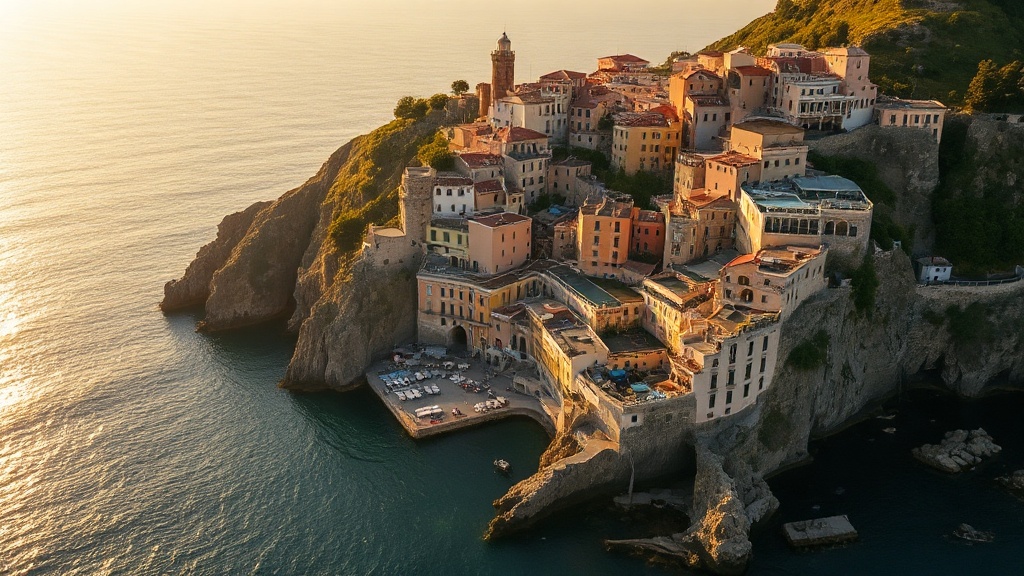
Cinque Terre — the five cliff-hugging villages of the Ligurian coast — is not a gateway city but a destination that requires planning. Genoa airport (90 km north) and Pisa (90 km south) are the two realistic entry points. A train from La Spezia Centrale, the nearest major hub, reaches Riomaggiore in 4 minutes and Monterosso in about 25.
The villages are small and, frankly, overcrowded in July and August. If you’re flying to Italy in 2026 specifically for Cinque Terre, target May or late September. The hiking trails are open, the weather cooperates, and you won’t be shoulder-to-shoulder on the Via dell’Amore.
8. Bologna — The City Italy’s Own Travelers Rate Highest
Fly into: Bologna Guglielmo Marconi (BLQ)
Bologna is the kind of place Italians recommend to each other, which is a better endorsement than any travel award. The airport is compact and well-connected — easyJet, Ryanair, and Wizz Air serve it from across Europe, with one-way fares often under €50 from major hubs.
The city is Italy’s food capital in the most literal sense: ragù bolognese, mortadella, tortellini in brodo all originated here. It’s also home to the oldest continuously operating university in the world (founded 1088), which gives it a young, intellectually alive energy that’s rare in heavily touristed Italian cities.
Honest tradeoff: Bologna is a genuinely rainy city — November through February averages 10–13 rainy days per month. Factor that in if you’re planning a winter trip.
9. Puglia — The Long Boot’s Heel
Fly into: Bari Karol Wojtyła (BRI) or Brindisi (BDS)
Puglia has been quietly building its international airport connections over the past five years, and by 2026 Bari handles direct flights from London Stansted, Amsterdam, and several German cities. From the US, you’ll connect through Rome or Milan, adding about 2–3 hours to your total travel time versus flying direct to Rome.
The region rewards the extra effort. Trulli houses in Alberobello, the white-washed town of Ostuni, baroque Lecce (sometimes called “the Florence of the South” — a comparison I find half-true and half-marketing), and some of Italy’s best sea-to-table seafood make this one of the country’s most rewarding road-trip circuits.
10. Lake Como — The One That Lives Up to the Photos
Fly into: Milan Malpensa (MXP) or Milan Linate (LIN)
Lake Como is 50 km north of Milan, reachable by train from Milano Centrale to Como San Giovanni in about 40 minutes. It’s genuinely beautiful in the way that few heavily photographed places actually are when you arrive — the light off the water in early morning, the ferry connections between villages, the mix of ornate 19th-century villas and working-class lakeside towns.
That said, villa towns like Bellagio and Varenna get extremely crowded from June through August. Late April and October are the sweet spots: the ferries are running, most restaurants are open, and hotel rates drop by 30–40% versus peak summer pricing.
Honest tradeoff: Como is not cheap even in shoulder season. A two-night stay in a mid-range hotel in Bellagio runs €200–€300/night in high season. The villages on the western shore — Lenno, Tremezzina — offer similar scenery at meaningfully lower prices.
How to Build Your Italy Flight Strategy for 2026
A few practical notes before you book:
- Best fare windows: For Italy in summer 2026, the sweet spot for booking transatlantic flights is roughly January through March 2026. Prices tend to climb steeply after spring break.
- Rome as hub: Even if your primary destination is Sicily or Puglia, positioning a Rome layover on your outbound or return leg often unlocks cheaper fares than flying directly into secondary airports.
- Italy’s rail network is your friend: The Frecciarossa and Italo high-speed trains connect Rome, Florence, Bologna, Venice, and Milan at speeds that often beat flying once you factor in airport time. A Rome–Florence ticket booked in advance runs as low as €19.
- ITA Airways’ transatlantic routes: ITA (Alitalia’s successor) has been expanding its US routes — check JFK–FCO, MIA–FCO, and LAX–FCO before defaulting to legacy carriers.
- Low-cost European hops: Once in Europe, Ryanair, easyJet, and Wizz Air can move you between Italian cities for under €40 if booked 6–8 weeks out.
Your Next Step
Pull up Google Flights right now, set your home airport, and run a flexible-date search to Rome FCO or Milan MXP for April–May or September–October 2026. Enable the “price graph” view, toggle to a 2-week window, and look for the fare dips — they’re there, and they’re real. Once you’ve locked in the transatlantic leg, the rest of the Italy puzzle gets considerably easier to solve.