

Now Reading: Stay Safe Abroad in 2026: 9 Essential Tips for Solo Travelers
- 01
Stay Safe Abroad in 2026: 9 Essential Tips for Solo Travelers
Stay Safe Abroad in 2026: 9 Essential Tips for Solo Travelers
Solo travel is rewarding in ways that group trips rarely are — but it also means there’s no one else watching your back. Get these nine habits right before you fly, and you’ll spend far less of your trip looking over your shoulder.
1. Book Flights That Don’t Leave You Stranded at 2 a.m.
Your safety strategy starts at the booking screen, not at the destination. Late-night arrivals at unfamiliar airports — especially at smaller regional hubs — are one of the most avoidable risk factors for solo travelers.
What to look for:
- Arrive at your destination airport between 9 a.m. and 7 p.m. local time whenever possible. Daytime arrivals mean open transport desks, visible staff, and easier navigation.
- Check whether your arrival terminal has 24-hour staffing. Many budget terminals at airports like Stansted (London) or Kuala Lumpur’s KLIA2 scale down services after midnight.
- If a red-eye is unavoidable, pre-book an airport transfer through your accommodation — not a random kiosk in arrivals.
Honest tradeoff: Daytime flights in popular markets (think transatlantic routes in June–August) can run $80–$200 more than overnight options. For routes under five hours, that premium is usually worth it. For long-haul, a business-class upgrade or a solid airport lounge for the layover may be a smarter spend than timing gymnastics.
2. Register With Your Government Before You Depart
This takes about ten minutes and costs nothing. The U.S. State Department’s Smart Traveler Enrollment Program (STEP) lets you receive real-time safety alerts for the country you’re visiting and makes it easier for embassy staff to reach you in an emergency. The UK has FCDO travel registration; Australia uses the Smartraveller system.
Register for every country on your itinerary — including brief layovers of 24 hours or more. If a civil unrest situation develops in a transit country while you’re in the air, you want an embassy already knowing your name.
3. Buy Travel Insurance That Actually Covers What Can Go Wrong
In 2026, the bare minimum is a policy that covers medical evacuation (look for at least $500,000 in medevac coverage — international helicopter and air ambulance costs can exceed $250,000 easily), trip interruption, and gear theft.
What solo travelers specifically need to check:
- “Cancel for any reason” (CFAR) riders — standard policies won’t cover you if you simply feel unsafe and need to leave early. CFAR typically adds 40–50% to the base premium but gives you an exit.
- Pre-existing condition waivers — only valid if purchased within 10–21 days of your first trip deposit, depending on the insurer.
- Adventure sports coverage — if you’re hiking, motorcycling, or diving, most base policies exclude injuries from these activities by default.
Policies from providers like Allianz, World Nomads, or IMG Global typically start around $60–$120 for a two-week trip for travelers under 35. Prices climb steeply after 60, so compare early.
4. Secure Your Devices Before You Leave Home
Your phone is your map, your bank, your boarding pass, and your emergency contact list. Treat it like the critical infrastructure it is.
- Enable full-disk encryption on both your phone and laptop (standard on iOS 16+; enable via Settings on Android).
- Turn on two-factor authentication for email, banking, and social media — and use an authenticator app, not SMS, since SIM-swap scams are increasingly common in Southeast Asia, West Africa, and parts of Latin America.
- Download offline maps (Google Maps or Maps.me) for every destination city before you board. Roaming data in countries like Japan or Colombia is reliable, but rural coverage is not.
- Set up a travel-only eSIM through providers like Airalo or Holafly. A local data plan in most destinations runs $10–$25 for 10–15 days, and it keeps your home SIM locked away — reducing SIM-swap exposure.
Honest tradeoff: Keeping two SIMs active means managing two phone numbers. Tell one trusted person back home which number to call in an emergency.
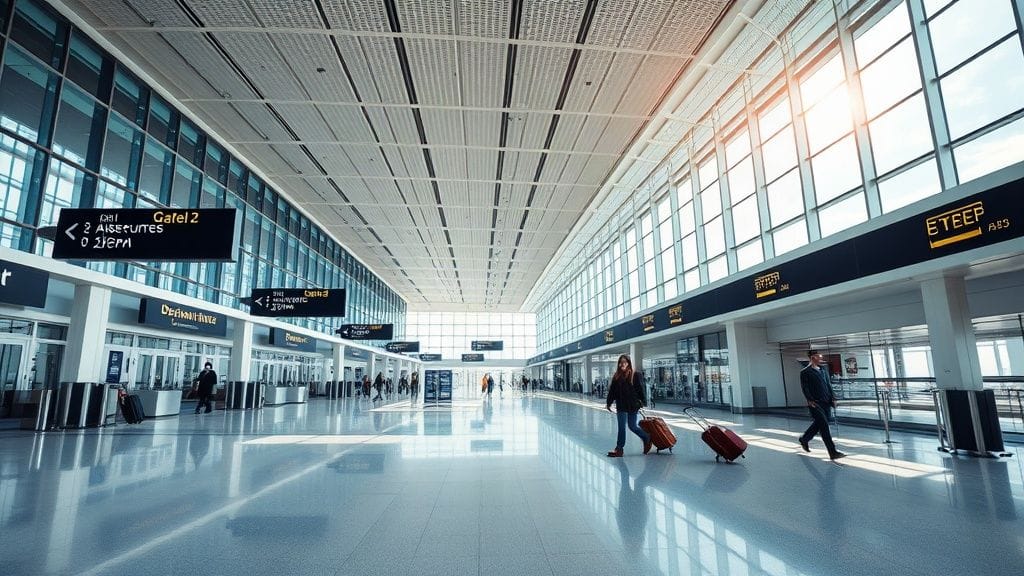
5. Know Your Airport Before You Land
I spent 40 minutes at Manila’s NAIA Terminal 1 in late 2024 trying to figure out why the taxi queue was full of unlicensed touts — because I hadn’t researched that Terminal 1 is the oldest and most chaotic of the four. Ten minutes of research before departure would have told me to use the Grab app instead.
For every arrival airport:
- Identify which terminal you’re arriving into — major airports like Bangkok’s Suvarnabhumi, Istanbul, and Dubai all have multiple terminals with very different exit logistics.
- Know the official ground transport options: metered taxi stands, app-based ride-hailing, rail links. Note the approximate fare range. Suvarnabhumi to central Bangkok by metered taxi runs roughly $10–$15 USD including expressway tolls; anyone quoting $40–$50 upfront is marking up heavily.
- Screenshot the airport map — specifically exit doors and official taxi/rideshare pickup zones — and save it offline.
6. Share a Live Itinerary With Someone You Trust
Not a vague “I’ll be in Thailand for three weeks” message — an actual, updated itinerary with flight numbers, accommodation names, addresses, and phone numbers.
Use a shared Google Doc or a dedicated app like TripIt Pro (around $49/year) that automatically parses booking confirmation emails. Give one person at home view access.
Update the document every time you change accommodation or alter plans by more than 48 hours. If you go silent unexpectedly, that document is what gets search-and-rescue teams to the right city.
7. Learn the Local Emergency Numbers — and Alternatives
112 works as an emergency number in most of Europe and connects to local services. But globally, numbers vary:
- USA/Canada: 911
- Australia: 000
- Japan: 110 (police) / 119 (ambulance/fire)
- Mexico: 911 (since 2017)
- India: 112
Beyond the official number, identify:
- The nearest hospital with English-speaking staff (your travel insurer’s 24-hour assistance line can tell you this)
- Your country’s nearest embassy or consulate address and after-hours phone number
- The non-emergency police number for the city you’re in — useful for reporting theft without tying up emergency lines
Store all of these in a notes app offline, not just in your contacts, in case your phone screen breaks but you can still borrow someone else’s device.
8. Manage Your Money So One Theft Doesn’t End Your Trip
Cash theft and card skimming remain the most common financial crimes targeting tourists in 2026. A few structural habits prevent one bad moment from becoming a catastrophe.
Card strategy:
- Carry two debit/credit cards from different networks (e.g., one Visa, one Mastercard) stored in separate bags.
- Use a card with no foreign transaction fees — Charles Schwab, Wise, and Revolut all offer solid options. Foreign transaction fees of 2–3% add up fast on a month-long trip.
- Enable transaction notifications on all cards so you see charges the moment they post.
- Set a daily ATM withdrawal limit (typically adjustable in your bank app) to cap exposure if your card is compromised. Keeping it at $300–$400 USD equivalent is a reasonable ceiling.
Cash strategy:
- Keep only one day’s spending cash in your wallet. Store the rest in a money belt or a locked bag in your accommodation.
- In high-theft areas (Barcelona’s La Rambla, Rome’s Colosseum zone, Bali’s Kuta), keep a “sacrifice wallet” with a small amount of cash and an expired card — hand it over if confronted and walk away.
Honest tradeoff: Carrying minimal cash feels uncomfortable, especially in countries where card acceptance is patchy (Vietnam, Morocco, much of sub-Saharan Africa). Research your destination’s cash culture in advance and calibrate accordingly.
9. Trust Your Gut — and Have an Exit Script Ready
This one sounds soft, but it has hard edges. Research consistently shows that people who act on early discomfort in unfamiliar situations avoid a large proportion of travel incidents. The challenge is social pressure: we’re trained not to be rude, not to offend.
Practical tools for exiting uncomfortable situations:
- The “bad reception” move: Pretend your phone is ringing, answer it, and walk away from a person or situation that feels off. Simple, culturally neutral, effective everywhere.
- A pre-memorized local phrase: In any country you visit for more than a few days, know how to say “I need to leave now” in the local language. Google Translate’s offline mode works fine for this.
- The “friend is waiting” line: If someone is pressuring you into a taxi, tour, or shop, “my friend is meeting me at the corner in five minutes” is a low-conflict exit that works in most cultures.
- Pre-booked accommodation for night one: Always. Even if you plan to freelance your accommodation after that, arriving with a confirmed booking and a named destination gives transport drivers a verifiable address — and you a safe base from which to get your bearings.
The flight home is also an exit option. If a destination feels genuinely dangerous and not just unfamiliar, check your airline’s same-day change fees before you go — many full-service carriers charge $75–$200 for voluntary date changes, while budget carriers may charge as much as the original fare. Knowing this in advance means you can make a rational decision, not a panic one.
Take One Concrete Step Right Now
Open your next booking confirmation and check your arrival time. If it’s after 9 p.m. local time, search for a same-route morning alternative on Google Flights — filter by arrival time using the “Arriving” slider under “Times.” If the price difference is under $100, switch. If it’s more, at least pre-book a reputable airport transfer before you close the tab.
That ten-minute audit is the most underrated thing you can do for your safety on the next trip.








Pingback: Top 10 Budget Hostels in Europe for 2026