Now Reading: 10 Essential Backpacking Tips Every First-Timer Needs in 2026
- 01
10 Essential Backpacking Tips Every First-Timer Needs in 2026
10 Essential Backpacking Tips Every First-Timer Needs in 2026
Backpacking in 2026 is cheaper, more connected, and more competitive than ever — and that last part is what’ll bite you if you’re not prepared.
Airfare algorithms have gotten sharper, hostel beds in popular corridors sell out weeks in advance, and carry-on fee structures have quietly gotten more punishing. The good news: none of this is hard to navigate once you know the rules. Here’s what I wish I’d known before my first solo trip, updated for the way travel actually works right now.
1. Book Your First Flight at Least 6–8 Weeks Out
The sweet spot for booking international budget flights hasn’t changed as dramatically as airlines would like you to believe. Research consistently shows that 6–8 weeks before departure is where you’ll find the best balance of availability and price on routes into backpacker hubs like Bangkok (BKK/Suvarnabhumi), Lisbon (LIS), or Mexico City (MEX).
Booking too early — say, six months out — often means paying a premium before airlines have discounted unsold inventory. Booking last-minute on popular routes means you’re gambling, and in 2026, you’ll usually lose that bet.
Tradeoff: If your dates are totally flexible, tools like Google Flights’ price calendar and Hopper’s “watch” feature genuinely help. If you have a fixed window (school break, work leave), flexibility disappears and 6–8 weeks becomes even more critical.
2. Fly Into Hub Airports, Then Use Budget Carriers Locally
Don’t fly directly into your first “real” destination if it means paying $300 more. Fly into the regional hub and connect cheap.
A good example: flying into Kuala Lumpur International (KUL) instead of directly into Chiang Mai (CNX) can save $150–$200 on the transatlantic leg, and AirAsia or similar low-cost carriers cover the KUL–CNX hop for typically under $40 if booked a few weeks out.
- Southeast Asia: KUL, BKK, and Singapore Changi (SIN) are your entry hubs
- Europe: London Gatwick (LGW), Amsterdam Schiphol (AMS), and Lisbon (LIS) offer the most onward budget options
- Latin America: Bogotá El Dorado (BOG) and Mexico City (MEX) are the two best budget-flight distribution centers
3. Pack for a 40-Liter Bag — No Exceptions
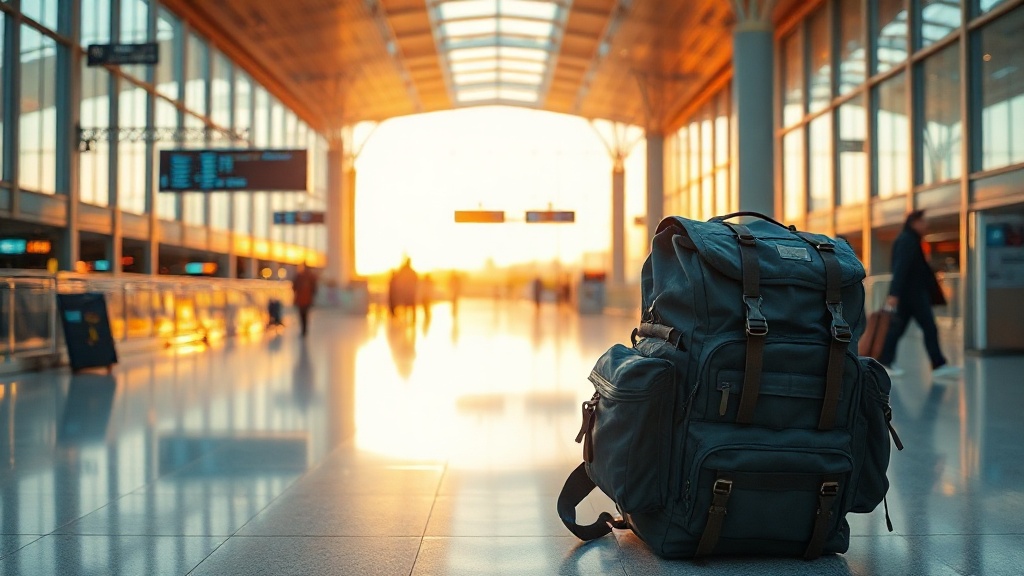
This is the one tip experienced backpackers give most and first-timers ignore most. A 40-liter bag fits in most aircraft overhead bins and under seats, qualifies as a personal item or carry-on on the majority of carriers, and keeps you moving fast at airports.
Go bigger and you will pay for it — literally. In 2026, checked baggage fees on budget carriers like Ryanair, Wizz Air, and Frontier range from $30 to $70 per flight. On a three-week trip with eight flight legs, that’s potentially $560 in fees on top of your ticket prices.
Honest tradeoff: A 40-liter limit means doing laundry every 5–7 days. That’s not a hardship — most hostels and guesthouses have laundry service for $2–$5 per load, and doing laundry is one of those slow travel moments that actually makes a trip feel real.
4. Get a No-Foreign-Transaction-Fee Card Before You Leave
This one’s purely administrative, but it matters. Standard credit and debit cards charge 1%–3% on every foreign transaction. On a $3,000 backpacking trip, that’s up to $90 in fees you could completely avoid.
In the US, the Charles Schwab debit card is the go-to rec for backpackers because it also refunds ATM fees worldwide. Wise (formerly TransferWise) is the preferred card for most other nationalities. Apply at least 2–3 weeks before your departure date — both have mail delivery times that’ll catch you out if you leave it to the last minute.
5. Don’t Skip Travel Insurance — Especially for Flight Disruptions
In 2026, flight disruption rates remain elevated post-pandemic restructuring. Travel insurance isn’t exciting, but a single missed connection that strands you overnight in an airport hotel can cost $200–$400 out of pocket. A medical emergency abroad can cost tens of thousands.
Policies through providers like SafetyWing (popular with long-term backpackers) run roughly $40–$50 per month for travelers under 40. That’s not nothing, but it’s less than one night in an airport hotel.
Look specifically for policies that cover:
- Trip interruption and missed connections
- Emergency medical evacuation
- Gear theft (especially electronics)
- COVID-related cancellations if that’s still relevant on your route
6. Use the “Tuesday–Wednesday Departure” Rule for Cheap Fares
This still holds up. Flights departing on Tuesdays and Wednesdays are consistently cheaper than Friday or Sunday departures — often by $50–$120 on transatlantic routes and $20–$60 on shorter hops.
I booked a New York (JFK) to Lisbon (LIS) flight departing on a Wednesday in March 2025 for $387. The same routing on the following Saturday was $541. Same airline, same cabin. The day of week was the only variable.
Tradeoff: Mid-week departures mean arriving mid-week, which can actually work in your favor — hostels are less crowded, attractions have shorter lines, and local transport is less chaotic on a Wednesday than a Sunday.
7. Research Visa Requirements at Least 3 Months Out
Visa rules in 2026 are in flux. The EU’s ETIAS (European Travel Information and Authorization System) is now fully operational for travelers from visa-exempt countries including the US, Canada, and Australia. It costs €7 and is valid for three years, but it requires online processing and can take up to 30 days in edge cases.
Similarly, several Southeast Asian countries updated their visa-on-arrival policies between 2024 and 2026. Vietnam, for example, extended its e-visa validity. Always check the official embassy website of your destination country — not a third-party service that might be selling you the same form for $50.
- EU (ETIAS): €7, apply online at the official ETIAS website
- India: e-Visa required for most nationalities; apply 4–7 days minimum before arrival
- Brazil: Visa-free for US citizens restored; confirm current status before booking
8. Fly Into One City, Out of Another — Don’t Backtrack
Open-jaw tickets (flying into City A and out of City B) often cost the same or only marginally more than round-trips, and they eliminate expensive backtracking. More importantly, they free your itinerary from the tyranny of returning to your starting point.
Flying into Bangkok (BKK) and out of Ho Chi Minh City (SGN) after traveling overland through Cambodia and Vietnam is a classic example. The open-jaw fare is typically within $30–$80 of a BKK round-trip, but you save two internal flights and the time of retracing your steps.
Google Flights handles open-jaw searches well — just enter your origin in the “from” field and toggle to a multi-city search.
9. Build Buffer Days Around Every Major Flight
This is the tip that separates first-timers from people who’ve done this before: always build in at least one buffer day before a major international departure.
If your outbound flight from London Heathrow (LHR) leaves on a Friday morning, don’t plan to arrive in London from Edinburgh on Thursday night. One delayed train, one overbooked hostel bed, one passport left in a locker — and you’re in serious trouble.
Buffer days also solve the jet lag problem on arrival. Landing in Tokyo (NRT) and immediately trying to execute a packed itinerary is a recipe for a miserable first 48 hours. Land, sleep, eat something local, then explore.
Tradeoff: Buffer days cost money — typically $30–$60/night in a hostel dorm. Factor them into your budget up front rather than treating them as an unplanned expense.
10. Set a Daily Budget and Track It From Day One — Not Day Three
Most first-timers “start tracking properly” on day three or four, by which point they’ve already blown their first week’s budget on airport meals, a taxi they didn’t need, and a too-nice hotel the first night because they were tired.
A realistic daily backpacker budget by region in 2026:
- Southeast Asia (Thailand, Vietnam, Cambodia): $35–$55/day including accommodation, food, and local transport
- Eastern Europe (Poland, Hungary, Romania): $50–$70/day
- Western Europe (Portugal, Spain): $70–$100/day
- Latin America (Colombia, Peru, Mexico): $40–$65/day
Use Trail Wallet or a simple spreadsheet on your phone. Log every purchase same-day. It takes 90 seconds and prevents the “I’ll add it up later” spiral that ends with a maxed credit card in week two.
One More Thing: Stop Optimizing and Start Booking
First-time backpackers often spend more time researching than any extra research is actually worth. At some point — usually around week six of “planning” — the marginal value of more research drops to near zero and the cost of not booking (higher fares, sold-out accommodation) starts rising.
Once you’ve locked in your flights using the tips above, head to Hostelworld or Booking.com, filter for properties rated above 8.5 by previous guests, and book your first two or three nights at each destination. Leave the rest open. That’s the actual sweet spot between over-planning and winging it.
Your concrete next step: Open Google Flights right now, set your destination, and check the price calendar for 6–8 weeks from today. Compare a Tuesday or Wednesday departure against the weekend. If the gap is $50 or more, you have your answer — and your first booking decision is already made.